

How much does it cost to go to Pakistan?
When budgeting for Pakistan, you'll need to plan for five main things:
- Flights
- Visas
- Accommodation
- Food
- Local transport
Your final bill comes down to how you like to travel, ranging from extreme budget backpacking to all-inclusive managed tours.
Speaking from personal experience, you will be pleasantly surprised by how far your money goes here. Pakistan is incredibly cheap for solo travelers. While cities like Lahore might stretch your wallet slightly more than remote mountain villages, careful planning makes it easy to control your spending.
What is the average daily travel budget?
Your daily spending depends on where you sleep and eat. A $60 mid-range daily budget gives you room for a few comforts, such as:
- Private hotel rooms
- Sit-down restaurant meals
- Guided sightseeing expenses
Backpackers in Pakistan typically rely on a $13.75 daily average. They manage this by taking cheap local transport and prioritizing street food. Traveling solo gives you total control over your wallet, especially when you avoid expensive group tours or luxury guides.
How much money do I need for a weekly or monthly trip?
Staying longer in Pakistan often brings your daily average down, making extended trips surprisingly affordable. As a baseline, a one-week trip usually costs around $390 for one person or $735 for two people. For a one-month trip, expect to spend an average of $1,600 for one person and $3,250 for two people.
Long-term visitors reduce their overall monthly travel costs through local hospitality and price negotiation. You can save a lot on hotels by booking longer stays. Visitors save even more money by managing food costs and using affordable local transportation, which drastically decreases weekly travel expenses.
Pakistan travel cost breakdown
| Category | Estimated Cost | Details |
|
Daily budget |
$13.75 – $60 |
|
|
Total trip cost |
$390 – $3,250 |
|
|
Flights |
$339 – $891 |
|
|
Visa |
$5 – $60 |
Pakistan E-Visa fees vary depending on the applicant's nationality. |
|
Accommodation |
$5 – $50 per night |
|
|
Food |
~$15 per day |
Average food and meal budget, heavily relying on cheap street food like kebabs and biryani. |
|
Local transport |
Varies by type |
|
|
Sightseeing & trekking |
500 Rs – $250 |
|
|
Travel insurance |
$40 – $100 |
Cost for a standard policy to cover health emergencies and travel disruptions. |
How much do flights to Pakistan cost?
Flight prices depend on where you're flying from, but cheap flights from the United States start as low as $339. The country features three primary entry hubs:
- Jinnah International Airport in Karachi
- Allama Iqbal International Airport in Lahore
- Islamabad International Airport in Islamabad
To find cheap flights, you'll need to get creative. Cost-saving methods, such as using hacker fares and booking separate one-way tickets across different airlines, can help you get there for less. Passengers save up to 16% on total ticket prices by choosing flights with layovers instead of direct routes.
Which season offers the cheapest international airfare?
September stands out as the cheapest time of year to fly, with average international airfare hovering around $891. February is also cheap, but if you travel during peak season, expect inflated prices.
Finding the best flight deals for arrivals in major cities like Karachi, Lahore, and Islamabad requires planning around off-season travel. Avoiding peak months is the easiest way to save money.
What are the Pakistan visa fees?
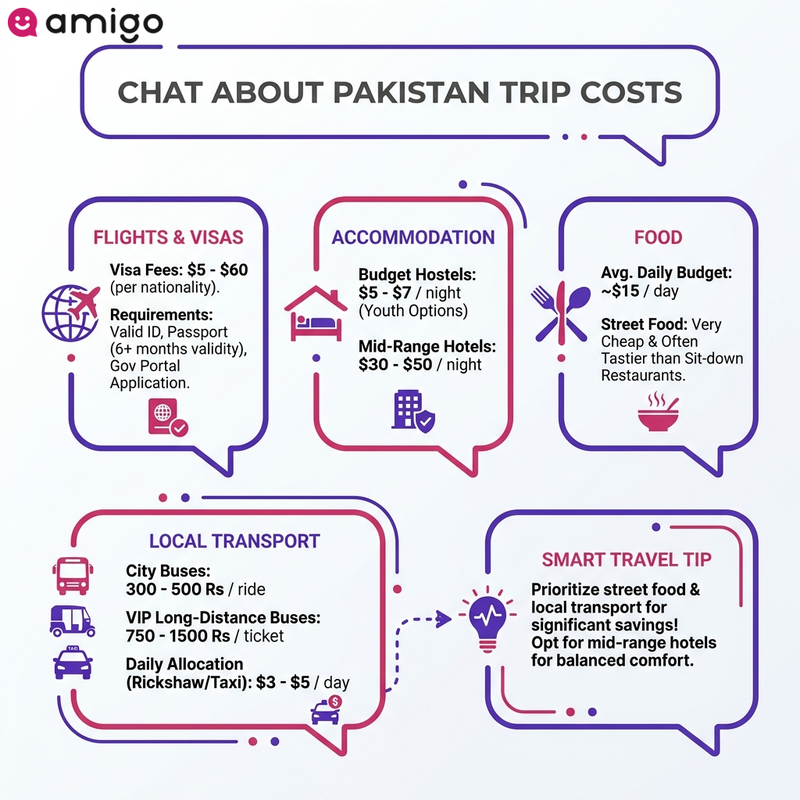
Don't forget to set aside some cash for your Pakistan E-Visa. Visa fees generally range from $5 to $60, depending on the applicant's nationality. Processing a tourist visa requires submitting specific travel documents, such as a valid ID and a passport valid for at least 6 months, through the official government portal. You'll need to pay the fee online using a credit or debit card when you submit your application.
Make sure to factor this into your initial budget. Whether you're backpacking solo or joining a luxury tour, everyone has to pay this entry fee upfront.
How much does accommodation cost in Pakistan?
Accommodation in Pakistan caters to all budgets, ranging from cheap youth hostels to mid-range hotels. Budget youth hostels typically cost between $5 and $7 per night, while mid-range hotels range from $30 to $50 per night. These costs increase significantly during peak season. You can save a lot on rooms by visiting during the off-season.
Thanks to incredible local hospitality, you can find free places to stay using apps like Couchsurfing and community guest networks. Budget travelers frequently use these alternative options to cut down their monthly expenses.
What is the average food and meal budget?
The average food and meal budget for a visitor in Pakistan is around $15 per day. Eating street food in Pakistan is incredibly cheap—and often much tastier—compared to dining at traditional sit-down restaurants. Here is a quick pro-tip: always look for the street stalls with the longest lines of locals. Popular cheap options like kebabs, biryani, and chicken tikka provide substantial savings. Plus, the famous generosity of locals often leads to free meals or complimentary food samples for foreigners.
Budget travelers gravitate toward these street stalls to save cash. Eating local street food is one of the easiest ways to keep your trip cheap—skipping the hotel restaurant for a roadside vendor can cut your daily food bill in half.
How much does local transportation cost?
Navigating between and within Pakistani cities is inexpensive, making local transportation a minor part of the overall travel budget. The country offers various modes of public transport, including standard local buses, minivans, and long-distance VIP buses. Local city buses cost between 300 and 500 Rs per ride. Upgraded intercity options make longer trips much more comfortable.
VIP long-distance buses cost between 750 and 1500 Rs per ticket. Visitors explore numerous major cities—such as Karachi, Lahore, Islamabad, Peshawar, Multan, Sialkot, and Quetta—using these affordable networks. Taking advantage of these transit networks is the best way to stretch your rupees. Taking the bus is a great way to get around cheaply.
What are the prices for domestic flights and trains?
When traveling between major cities, you essentially have two choices that fit very different budgets: flights or trains. Domestic flights save time but will definitely cost you more. These air routes quickly connect major cities to remote destinations, such as flights from Karachi and Islamabad to Quetta and Skardu.
Trains are a cheap and beautiful way to travel between cities. Railway routes connect cities like Lahore, Peshawar, Multan, and Sialkot. Train tickets remain inexpensive compared to airfare, helping independent travelers maintain a low daily budget.
How much do rickshaws and ride-sharing apps cost?
Travelers typically allocate between $3 and $5 per day for rickshaw rides and taxis. You haven't truly experienced Pakistani city life until you've bounced along in the back of a colorful rickshaw. Rickshaws are perfect for zipping through congested traffic in dense urban centers like Karachi, Lahore, Islamabad, Peshawar, and Multan, offering a cheap way to get around.
Ride-hailing apps provide fair, upfront pricing that eliminates the need to haggle over fares. You'll usually get a better deal using apps rather than flagging down a cab. Using these platforms helps save money on short trips.
What are the sightseeing expenses and entrance tickets?
Sightseeing in Pakistan is generally inexpensive, with very low entrance fees for protected areas like national parks and historical landmarks. Tickets to tourist attractions and cultural sites typically cost between 500 and 800 Rs. Visitors explore various renowned destinations, from the Lahore Walled City to ancient ruins. You won't spend much on daily sightseeing.
To save money in cities like Lahore or Peshawar, mix paid historical sites—like the Lahore Fort—with free experiences like wandering through local bazaars and public parks. Independent travel keeps these daily activity costs low compared to premium managed tour packages.
How much does it cost to trek in the northern areas?
Trekking up north is usually the priciest part of the trip because you often need guides and special transport. Reaching remote mountain valleys like Hunza and Skardu requires a significantly higher travel budget for specialized transport from Islamabad. Managed tour packages for these regions, such as guided glacier treks and basecamp expeditions, average $250 per day. I can honestly say the breathtaking views of the Karakoram mountains are worth every single penny.
While guided treks are expensive, going solo is much cheaper. Independent trekking lowers these expenses, but travelers must secure local permits directly if they avoid agency support.
Why should travelers use an eSIM card in Pakistan?
Getting an eSIM is one of the best ways to stay connected and navigate easily in Pakistan. Digital SIMs provide immediate convenience over physical ones for tourists requiring instant internet access upon arrival. For hassle-free connectivity, visitors often choose a dedicated eSIM card for Pakistan that activates instantly. This reliable connectivity helps you stick to your budget by allowing immediate access to digital services, such as ride-hailing apps and hostel booking platforms, which reduce the overall cost of the trip.
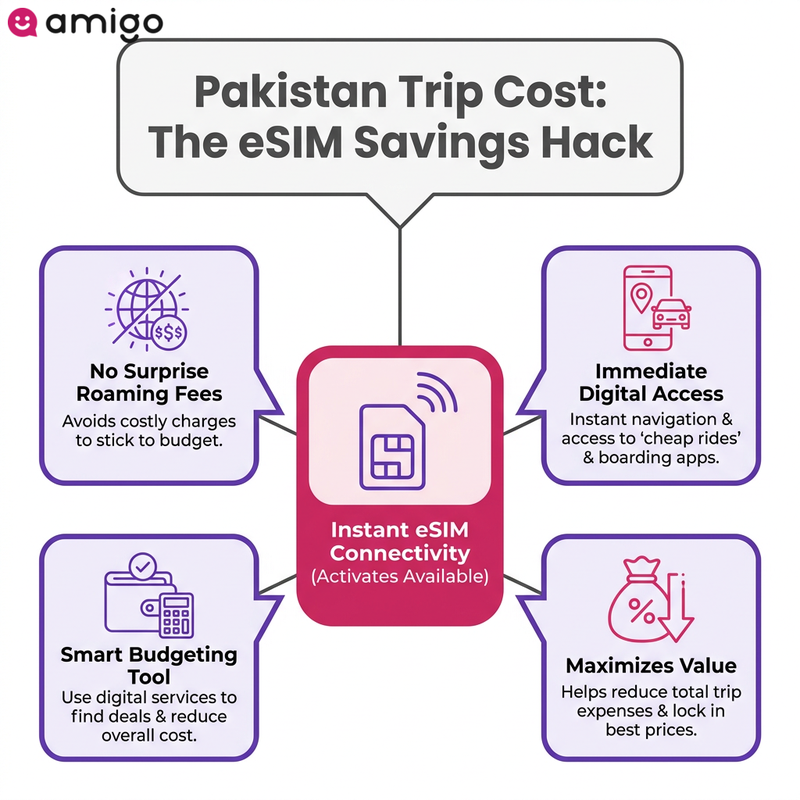
With an eSIM, you can easily pull up maps, hail cheap rides, and snag last-minute hotel deals without worrying about roaming charges, which saves you even more money. Having seamless internet access right off the plane means you won't get hit with surprise roaming fees, making it much easier to stick to your daily budget.
How much does travel insurance for Pakistan cost?
Travel insurance is an absolute must-have to protect against health emergencies and travel disruptions in remote Pakistani regions. While not legally mandated for entry, it's worth every penny for peace of mind. Comprehensive coverage is highly recommended for adventure tourism and rugged terrains, such as the high-altitude Northern Areas and isolated mountain valleys.
These remote locations present specific altitude risks and limited medical facilities. A standard policy usually costs between $40 and $100. It might seem like an annoying extra cost, but it can save you from massive medical bills. Visitors protect their weekly travel budget against unexpected cancellations by purchasing trip interruption coverage. Both independent travelers and those on premium managed tour packages benefit from this essential financial protection.
What is the cost difference between independent travel and managed tour packages?
Traveling independently costs a fraction of a managed tour, allowing you to explore Pakistan on a shoestring budget while controlling exactly where your money goes.
On the other hand, managed adventure tour packages are much more expensive but take care of all the planning for you. Managed tours typically cover various built-in expenses, including historical sight fees, dedicated local transport, and pre-booked accommodation. Comparing these two distinct styles is essential for calculating the exact cost of a trip to Pakistan. Visitors experience massive financial savings by organizing their own itineraries instead of relying on guided agencies.
How does the Pakistani rupee exchange rate affect your travel budget?
Because the Rupee fluctuates, your money might go a lot further depending on when you visit. A favorable currency exchange rate makes daily expenses drastically cheaper. Strong foreign currencies reduce the prices of essential travel categories, including local food, public transport, and accommodation.
Travelers safely obtain local currency via authorized foreign exchange agents or official ATMs immediately upon arrival. These secure financial services operate inside all major international entry points, such as Jinnah International Airport, Allama Iqbal International Airport, and Islamabad International Airport. You can grab cash at ATMs when you arrive, but avoid airport exchange kiosks if you want the best rates. As a quick piece of insider advice, always keep a stash of smaller rupee notes handy for tipping and street vendors.
Sources
- https://www.bts.gov/air-fares
- https://commons.erau.edu/cgi/viewcontent.cgi?article=1941&context=ijaaa
- https://visa.nadra.gov.pk/fee-structure/