

What is an IMEI number?
The International Mobile Equipment Identity (IMEI) is a unique 15-digit number. Think of it like a social security number for your phone. If you're like most of us, you probably haven't given this string of digits much thought until you suddenly needed it. It identifies mobile devices and verifies your hardware.
By keeping this hardware code completely separate from your personal subscriber data, carriers can manage device security and block stolen phones without interfering with your actual mobile account.
IMEI number breakdown and key concepts
| Category | Description | Key details |
|
IMEI definition and location |
A unique 15-digit hardware identifier for mobile devices used to manage security and network access. |
|
|
IMEI structure |
A specific format that lets networks know exactly what kind of phone is being used and verifies accuracy. |
|
|
IMSI comparison |
IMSI identifies the individual subscriber and network plan, whereas IMEI identifies the physical hardware. |
Stored securely on the SIM card; both codes must be verified together to grant network access. |
|
Serial number comparison |
Serial numbers are for internal manufacturer use (inventory, warranties), while IMEI is a global network ID. |
Serial numbers use variable alphanumeric formats, unlike the strict 15-digit IMEI standard. |
|
MEID comparison |
MEID functions primarily on CDMA networks, serving the same hardware identification purpose as IMEI. |
Uses a 14-digit hexadecimal format instead of a 15-digit decimal structure. |
|
Dual SIM and eSIM |
Devices require multiple unique IMEI numbers to connect to more than one network simultaneously. |
A secondary IMEI is essential for securely activating digital eSIM profiles and prepaid travel data plans. |
|
Security and tracking |
Carriers and law enforcement use IMEI to track, locate, and block stolen or lost phones globally. |
|
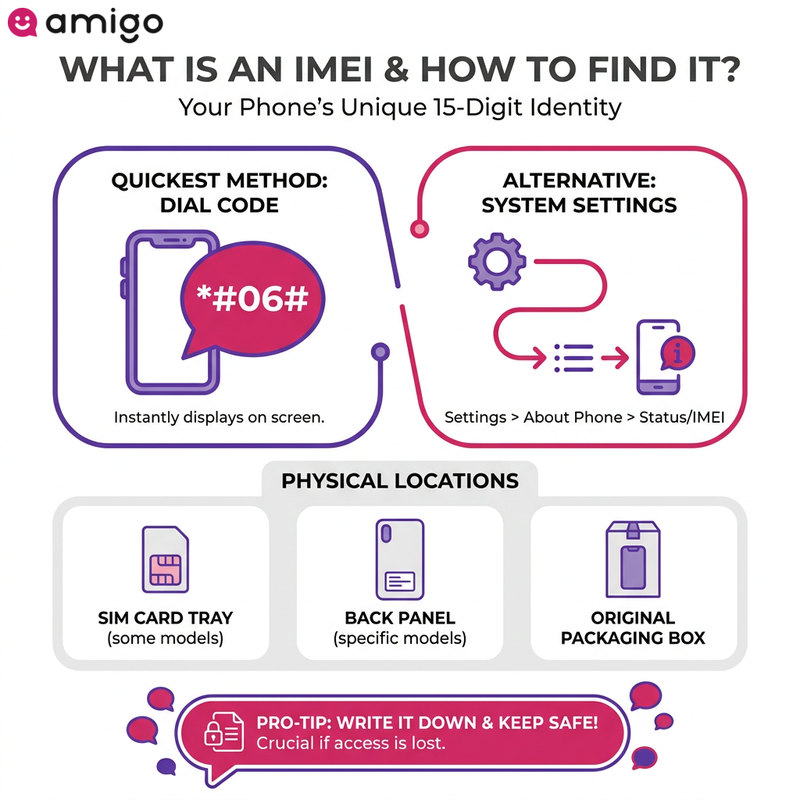
How can you find your device's IMEI number?
The quickest way to find your phone's IMEI is to simply dial *#06# on your keypad. This displays the identifier instantly on your screen. You can also locate the IMEI in the smartphone's system settings. Just go to your "About Phone" menu to see the code alongside the serial number. As a quick pro-tip, I highly recommend writing this number down and keeping it somewhere safe just in case your screen ever breaks and you can't access the menus.
You can also find the IMEI on the phone itself, including:
- The original packaging box
- The back panel of specific models
- The SIM card tray
With this number, users can access IMEI lookup services to check if the phone is genuine. Carriers rely on this identifier to let your phone connect safely to the network and manage device security.
What is the structure of an IMEI number?
The IMEI is a 15-digit number broken down into a few specific parts. This specific format lets networks know exactly what kind of phone you're using.
What is the type allocation code?
The Type Allocation Code (TAC) makes up the first 8 digits of an IMEI. It confirms legitimate device manufacturers and helps networks recognize exactly what device you have. The first two digits act as a reporting body identifier, indicating which specific global regulatory group approved the device.
What is the Luhn check digit?
The check digit is the 15th and final number in an IMEI sequence, making sure the whole number is correct. The system calculates this using the Luhn algorithm—the same mathematical formula that banks use to verify credit card numbers. This final digit acts as a typo-checker, preventing errors during manual data entry or transmission. Providers use this global standard to maintain network safety and confirm hardware identity.
What is the IMEI software version?
The IMEI software version (IMEISV) is a 16-digit variant of the standard IMEI. It replaces the single Luhn check digit with a two-digit software version number. Carriers track this software revision data to make sure the device is recognized correctly. This global standard improves how networks identify devices by verifying the exact system release that the device is running.
What is an IMEI number used for?
Your IMEI number is essential for a few main reasons:
- Device security
- Hardware validation
- Managing access to cellular services
Networks check this number every time your phone tries to connect to verify the hardware and prevent unauthorized network usage.
How does IMEI help track stolen phones?
Law enforcement and your provider use the IMEI to track, locate, and block stolen or lost phones. Following a theft report, providers add the 15-digit identifier to a local Equipment Identity Register (EIR). The Central Equipment Identity Register (CEIR) is a global database, allowing operators to share blocklist records and disable stolen IMEI numbers internationally.
Authorities use this data to conduct criminal investigations, such as lawful intercepts and location tracing.
What are IMEI blocklists and allowlists?
An IMEI blocklist stops a stolen phone from connecting to any network, rendering a stolen phone useless. Carriers enforce network protection by recording blacklisted devices, such as lost and stolen smartphones, in the EIR and CEIR. Adding an identifier to a blocklist prevents network connection even if the user swaps the SIM card.
On the other hand, an allowlist restricts access exclusively to pre-approved IMEI numbers, such as government-registered codes. Regulatory authorities use this standard to make sure only registered devices operate locally.
How does IMEI affect device warranties and insurance claims?
Insurance companies and manufacturers require the IMEI to verify a specific unit's identity when processing a device warranty or phone insurance claim. These organizations use the IMEI to check important details like active coverage status and hardware history. Public IMEI lookup services allow consumers and insurers to verify a clean history before approving a request.
A clean identifier is essential when buying or selling certified pre-owned devices, such as refurbished smartphones and used tablets. I always tell friends to run this quick check before handing over any cash for a second-hand phone. Insurers reject requests involving blacklisted devices to keep networks safe, and telecom companies cross-reference this 15-digit code alongside the serial number to prevent fraud. Without a clean, legitimate tracking record, your warranty or insurance claim will be denied.
How does IMEI compare to other mobile identifiers?
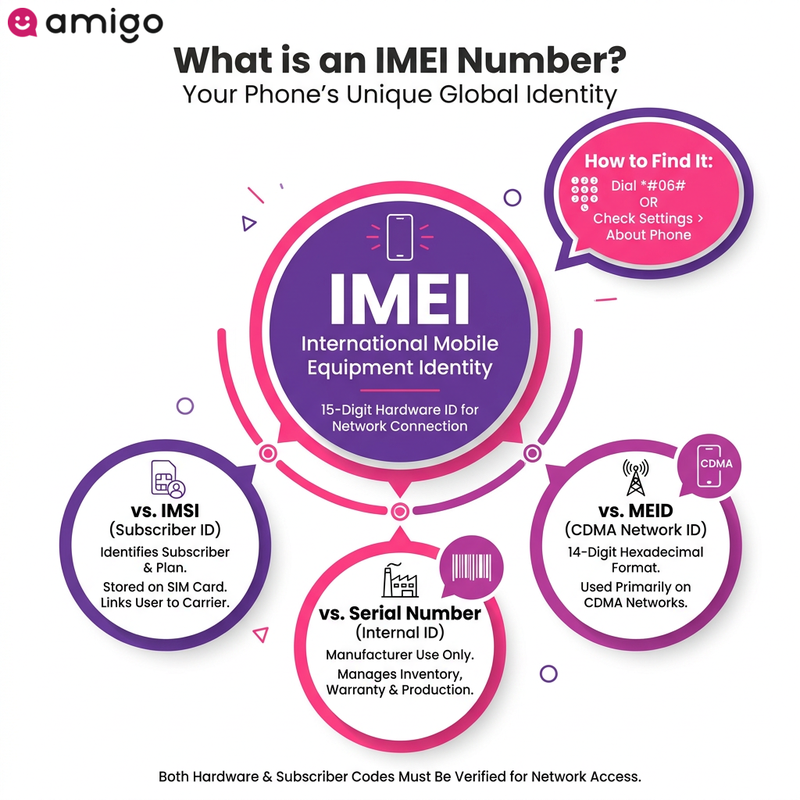
The IMEI uniquely identifies the physical hardware, while other codes serve different network or subscriber functions. Cellular networks use these distinct codes to allow you to connect safely, provided the hardware and subscriber codes match active database records.
What is the difference between IMEI and IMSI?
Simply put, the IMEI identifies the physical mobile device, while the International Mobile Subscriber Identity (IMSI) identifies the individual subscriber and their specific network plan. The SIM card securely stores the IMSI to link a user directly to carriers, including local and international carriers.
Manufacturers hardcode the IMEI directly into the hardware so it can always be identified. These two identifiers work as a pair: the IMEI proves your phone is a legitimate, unblocked device, while the IMSI proves you have an active, paid account with your carrier. Your carrier will only let you connect to the network once both of these codes are verified.
What is the difference between IMEI and a serial number?
Think of the IMEI as a global network ID, while the serial number is just for the manufacturer's internal use. Your phone has both to keep your network connection entirely separate from how the factory tracks its inventory. The IMEI maintains a strict 15-digit format that global standards establish to make sure devices are tracked the same way everywhere. But a manufacturer's serial number uses variable alphanumeric formats depending on the specific brand.
While both identifiers track hardware, cellular networks only use the IMEI to let your phone connect to the network. Manufacturers use the serial number exclusively for internal processes, such as:
- Managing inventory
- Tracking production dates
- Processing a device warranty
What is the difference between IMEI and MEID?
Cellular networks operate on two primary radio technologies: GSM and CDMA networks. The mobile equipment identifier (MEID) functions primarily on CDMA networks using a 14-digit hexadecimal format. Meanwhile, the IMEI uses a 15-digit decimal structure that is a global standard.
Both codes serve the exact same purpose: they allow your provider to verify that your phone is genuine and identify devices. Your provider will only grant network access if the hardware code matches their active database records.
How do dual SIM and eSIM devices use IMEI numbers?
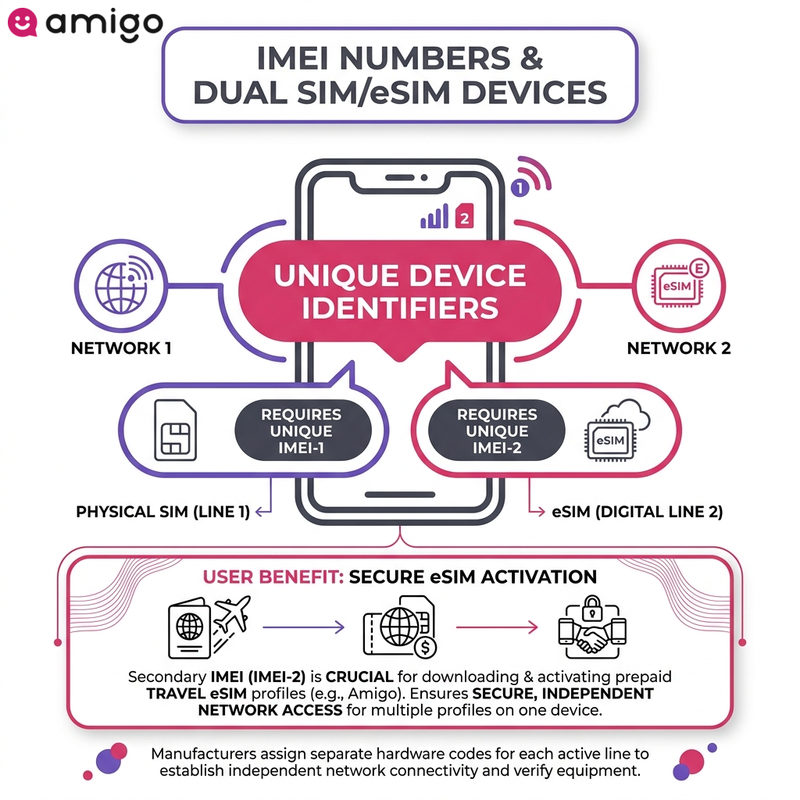
Devices with dual SIM or eSIM capabilities require multiple unique IMEI numbers to connect to more than one network at the same time. Manufacturers assign two separate hardware codes to devices like modern smartphones and cellular tablets.
This dual assignment helps networks recognize the device properly, as each active line requires its own dedicated identifier to establish independent network connectivity. Carriers read these distinct codes to verify equipment.
The IMEI is an essential part for registering and activating digital eSIM profiles. When you download a prepaid travel eSIM for your next trip—like those offered by Amigo—the provider uses your device's secondary IMEI to securely activate your new digital data plan. Local networks will grant access once your secondary IMEI matches an approved database record. This process keeps your connection secure while managing multiple active subscriptions on a single device.
How do IMEI lookup services work?
IMEI lookup services are public tools that decode a 15-digit IMEI to show important details about the phone, such as blacklist status, carrier lock restrictions, and warranty information. Consumers use these online checkers to verify the legitimacy of second-hand devices before purchase.
Lookup platforms cross-reference the provided identifier with global databases to verify if a phone has a lost or stolen status, which makes it much easier to track stolen phones across different carrier networks. By managing these centralized registries, telecom companies keep networks secure. Carriers immediately identify and block devices if the hardware matches an active theft report. Ultimately, this precise hardware check helps buyers avoid buying a phone they can't use.
Is it safe to share your IMEI number?
While necessary for specific tools like IMEI lookup services, sharing an IMEI publicly can be risky for your device's security. You'd be surprised how often I see people accidentally post an uncensored screenshot of their IMEI on social media when trying to sell a device. The IMEI is essentially a permanent device fingerprint for recognizing your phone. Exposing this identifier carries two primary security risks: device cloning and fraudulent blocklisting.
If a user posts the number on public forums, scammers can misuse this hardware code to clone stolen equipment or report legitimate hardware as compromised. This fraudulent activity can get a perfectly good phone blacklisted, preventing the phone from connecting to the network.
Providing this 15-digit code remains safe and necessary for authorized procedures, such as unlocking your phone from a carrier or verifying a secondhand sale with a reputable buyer. Carriers and trusted entities require this exact number to complete security checks. Restricting access exclusively to these authorized parties keeps the tracking systems secure.
Can you change or modify an IMEI number?
Changing a mobile device's IMEI number is technically difficult, violates manufacturer warranties, and is illegal in numerous global jurisdictions, including the United States and the United Kingdom. Manufacturers hardcode this 15-digit identifier directly into the physical components during production to make sure the device can always be identified. This physical integration makes it extremely hard to change the original code, as modifying the hardware requires specialized software and advanced technical manipulation.
Criminals use IMEI modification as a primary tactic to bypass active network blocklists and reactivate lost or stolen smartphones. This trick hides the fact that a phone is stolen so it can connect to the network again. Altering this unique code undermines established stolen phone tracking systems and disrupts standard hardware verification.
Providers rely on unaltered identifiers to protect their networks. Carriers will immediately deny network connectivity if they detect tampered hardware. Law enforcement agencies classify this tampering as a severe criminal offense because it's usually done to hide stolen phones.
How does your IMEI affect SIM-lock status and travel connectivity?
The IMEI is a key part of verifying a device's SIM-lock status and making sure your phone works with international networks and travel eSIM profiles. Carriers use this 15-digit identifier to process requests to remove a carrier restriction. Providers will unlock your device if the provided IMEI matches an eligible account in their database. This process lets you connect across different cellular networks, including domestic providers and foreign operators.
Travel eSIM providers require an IMEI check to check a few important details, such as an unlocked network status and technological compatibility with digital data plans. The IMEI precisely identifies the hardware to make sure the smartphone supports international frequencies. There is truly nothing worse than landing in a new country only to find out your phone won't connect, which is why this verification step is such a lifesaver.
Telecommunications companies read this hardware code to check your phone when you're setting up a travel plan. A device connects to foreign networks successfully if the identifier exists on a global allowlist and has no carrier restrictions.
Sources
- https://www.etsi.org/deliver/etsi_ts/123000_123099/123003/16.03.00_60/ts_123003v160300p.pdf
- https://www.gsma.com/get-involved/working-groups/terminal-steering-group/imei-database/
- https://www.legislation.gov.uk/ukpga/2002/31/notes