


How much does it cost to go to Ivory Coast?
Calculating the cost of a trip to Ivory Coast just takes a bit of preparation. Trust me, getting your budget sorted early will save you a lot of headaches later. The total vacation cost depends heavily on flight prices, accommodations, and daily activities, depending on how you like to travel.
You'll spend most of your money on local transportation, dining, and entrance fees for tourist attractions. Local transactions use the West African CFA Franc.
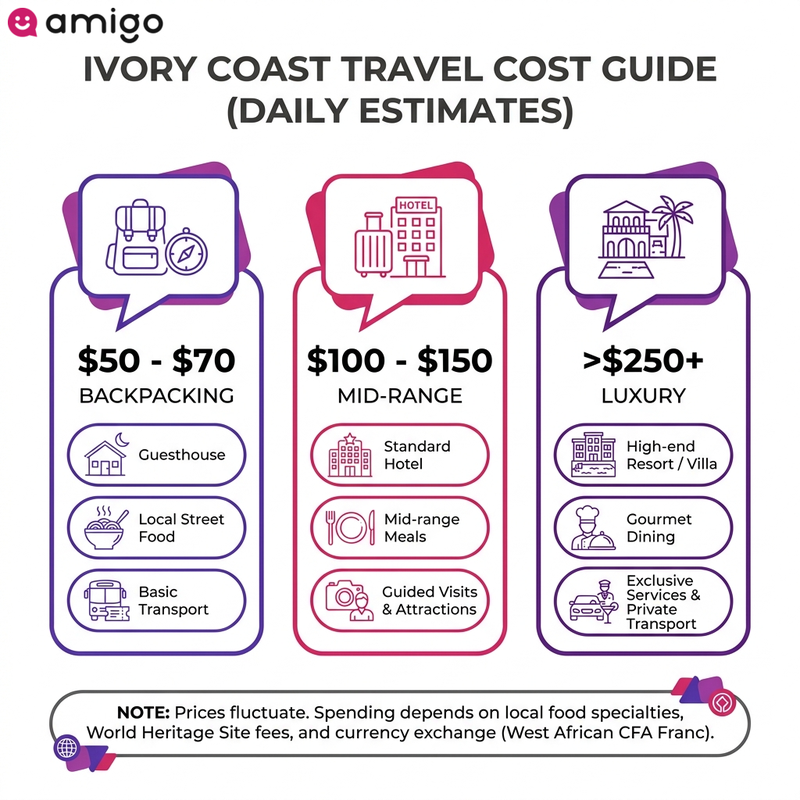
What is the average daily budget for different travel styles?
Daily budgets in Ivory Coast vary widely.
- If you're backpacking, expect to spend $50 to $70 per day, which covers a simple guest house, local street food, and basic transportation.
- For $100 to $150 daily, you can enjoy a mid-range trip with standard hotel accommodations and guided visits to tourist attractions.
- Luxury stays exceed $250 per day, staying in high-end resorts or private villas.
Calculated in the West African CFA Franc, your actual spending will change depending on things like purchasing local food specialties or paying entrance fees for UNESCO World Heritage Sites.
How does the West African CFA Franc affect local spending?
Cash is king in the country, as 90% of daily commerce in Côte d'Ivoire requires physical cash. You'll absolutely need cash if you're traveling on a budget, specifically for food vendors and local transportation like street stalls and shared minivans. Large hotel accommodations, such as international chain resorts and business suites, process electronic payments for a standard 3% surcharge.
Rural tourist attractions, including community markets and regional museums, operate strictly on physical money. From my experience, you'll want to keep plenty of small denominations handy to make haggling easier. Using cash helps you manage your daily budget much better once your major upfront costs—like flights, hotels, or all-inclusive packages—are already paid for.
Ivory Coast travel cost breakdown
| Category | Estimated cost | Details |
|
Daily budget |
$50 to $250+ per day |
|
|
Flights |
$804 to $1,138 |
|
|
Visa |
~73 Euros (~$80 USD) |
Electronic visa required for US citizens, valid for up to three months. |
|
Accommodation |
15,000 to 150,000+ West African CFA Franc per night |
|
|
Food and drink |
$15 to $40 per day |
|
|
Sightseeing and attractions |
5,000 to 25,000 West African CFA Franc per day |
|
|
Vacation packages |
Starts from ~$2,278 |
Multi-night bundles typically include international round-trip flights, domestic intercity transfers, and accommodation. |
What are the visa, passport, and travel insurance costs?
Before you fly, you must factor visa and passport fees into your total budget. US citizens require an approved electronic visa to enter Ivory Coast.
The online application process carries a set fee of approximately 73 Euros (around $80 USD) and grants a document valid for up to three months. You'll need a passport valid for at least six months beyond your date of entry. Don't forget to factor in the cost of a passport renewal if yours is expiring sooner.
Don't skip travel insurance—it's a lifesaver if you face unexpected emergencies like medical evacuations and trip cancellations.
Purchasing adequate coverage protects your investment when booking expensive vacation packages. Be sure to include these upfront costs in your overall budget before calculating your daily spending.
How much do flights to Ivory Coast cost?
What you pay for a flight depends on a few key things:
- Seasonality
- Booking timing
- Departure days
While standard round-trip tickets average $1,138, you can drop these costs to $804 if you book approximately 8 weeks before departure. Tuesday offers the cheapest day to fly, while Thursday represents the most expensive departure day.
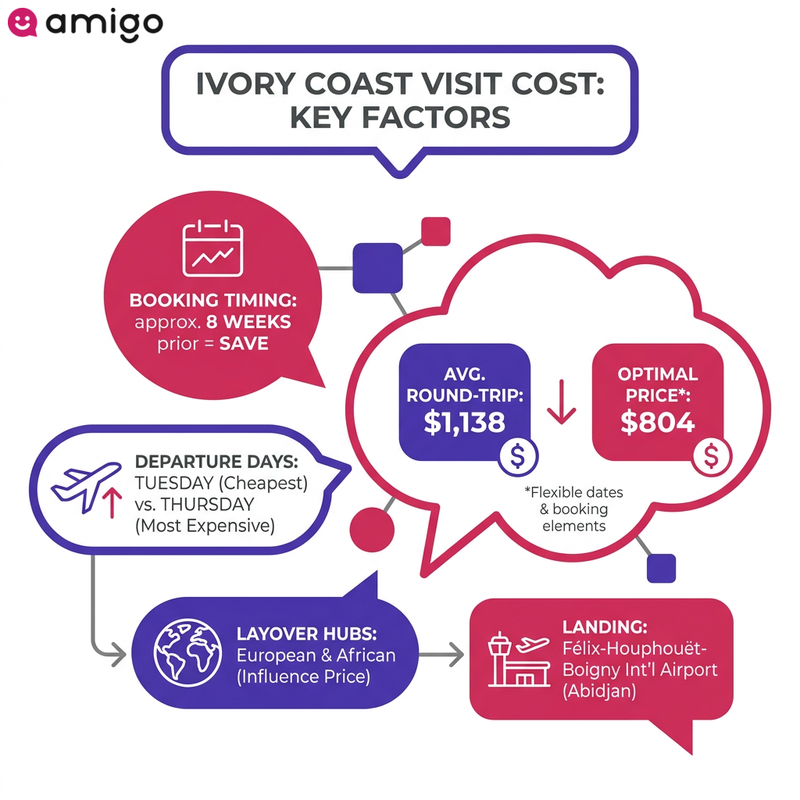
Because direct flights from North America are rare, your choice of European or African layover hub will heavily influence your final ticket price. Most international routes land directly at Félix-Houphouët-Boigny International Airport in Abidjan. Bundling these airfares into comprehensive vacation packages alters the final price. Being flexible with your dates is the best way to find a great deal.
When is the cheapest time to fly to Abidjan?
October offers the cheapest time to fly to Abidjan. Traveling during this off-peak season helps you save the most money on flights to Félix-Houphouët-Boigny International Airport, affecting both standard economy fares and premium rates. On the other hand, December and June represent the most expensive months in Côte d'Ivoire due to high demand, which increases costs like base airfares and baggage fees.
Affordable transit usually requires booking round-trip tickets and accepting layovers, as nonstop flights typically are much more expensive. Bundling purchases creates cost-effective vacation packages that include resort stays and guided tours. If you can keep your autumn schedule flexible, you'll save a lot on your trip.
Can vacation packages offer better value than independent booking?
Booking a package deal can often save you money by rolling your flights and hotel into one price. Multi-night vacation packages that bundle international round-trip flights, domestic intercity transfers, and accommodation start from approximately $2,278.
This strategy simplifies budget travel in Ivory Coast, freeing up your daily cash for souvenirs, extra sightseeing, and better meals.
How much do hotels and accommodations cost in Ivory Coast?
Total travel costs depend heavily on the choice between traditional hotels, vacation homes, and guest houses. For budget travelers, basic rooms start at 15,000 West African CFA Franc a night. If you want a bit more comfort, you'll find standard hotel accommodations averaging 50,000 to 80,000 West African CFA Franc per night. Meanwhile, premium stays will set you back over 150,000 West African CFA Franc daily.
Expect to pay more in major cities like Abidjan and Yamoussoukro than in rural areas. Lodging near these metropolitan hubs and popular tourist attractions commands higher nightly rates than remote villages in Côte d'Ivoire. Booking a package deal is a good idea if you want to know exactly what you'll spend upfront.
How much does food and drink cost in Ivory Coast?
Eating and drinking in Ivory Coast is highly affordable, especially if you stick to local dishes. Budgeting for daily meals means you generally have two choices for eating out: street food stalls and sit-down restaurants. Street food vendors in Abidjan offer the most cost-effective meals for budget travel. Trying local dishes like attiéké and kedjenou won't break the bank. I highly recommend grabbing a plate from a busy roadside vendor—it's often the most authentic meal you'll find. These local meals typically cost between 1,500 and 5,000 West African CFA Franc per plate.
Dining at mid-range restaurants near popular tourist attractions increases the daily food budget to approximately 10,000 to 20,000 West African CFA Franc per person. Plan to spend about $15 to $40 a day on food in Côte d'Ivoire.
If you want to lock in your food costs ahead of time, consider booking an all-inclusive resort or a tour that includes your meals. Relying on local markets rather than dining exclusively at expensive hotel accommodations saves you a lot of money.
How much does local transportation cost?
Don't forget to budget for getting between cities and to the airport. Airport transfers typically utilize shared buses or private cars, while inter-city travel relies on faster transport methods like local planes and long-distance taxis.
Booking domestic flights increases the total transportation budget if visitors travel between major cities like Abidjan and Bouaké. Exploring destinations like Yamoussoukro requires physical payments using coins and banknotes of the West African CFA Franc. Taking public buses or shared rides is the best way to keep your transport costs low.
How do car rentals compare to public transit like SOTRA buses?
While SOTRA buses offer a very cheap way to navigate Abidjan, car rentals provide necessary flexibility for reaching remote destinations, such as Man and the national parks, at a higher cost. Public transportation remains the smartest choice for budget travel if visitors stay within the city. As a quick pro-tip, always confirm the fare with your driver before getting in to avoid any surprises. The SOTRA bus line 6 provides a budget-friendly connection between Félix-Houphouët-Boigny International Airport and the city center.
How much do tourist attractions and sightseeing cost?
Allocating 5,000 to 25,000 West African CFA Francs daily covers standard sightseeing and attraction entrance fees in Côte d'Ivoire.
Visiting prominent landmarks and UNESCO World Heritage Sites, such as the Basilica of Our Lady of Peace in Yamoussoukro, charges an entrance fee. Attending regional celebrations like the Festival of Masks also requires buying a ticket.
What are the costs to visit Taï National Park, Comoé National Park, and Grand-Bassam?
Entrance fees for Taï and Comoé National Parks typically range from 5,000 to 10,000 CFA Francs, but mandatory guided tours and 4x4 rentals can add 50,000 to 100,000 CFA Francs to your daily budget. Meanwhile, exploring Grand-Bassam is largely free, with museum entries costing around 2,000 CFA Francs.
Why should you use an eSIM card for mobile data in Ivory Coast?
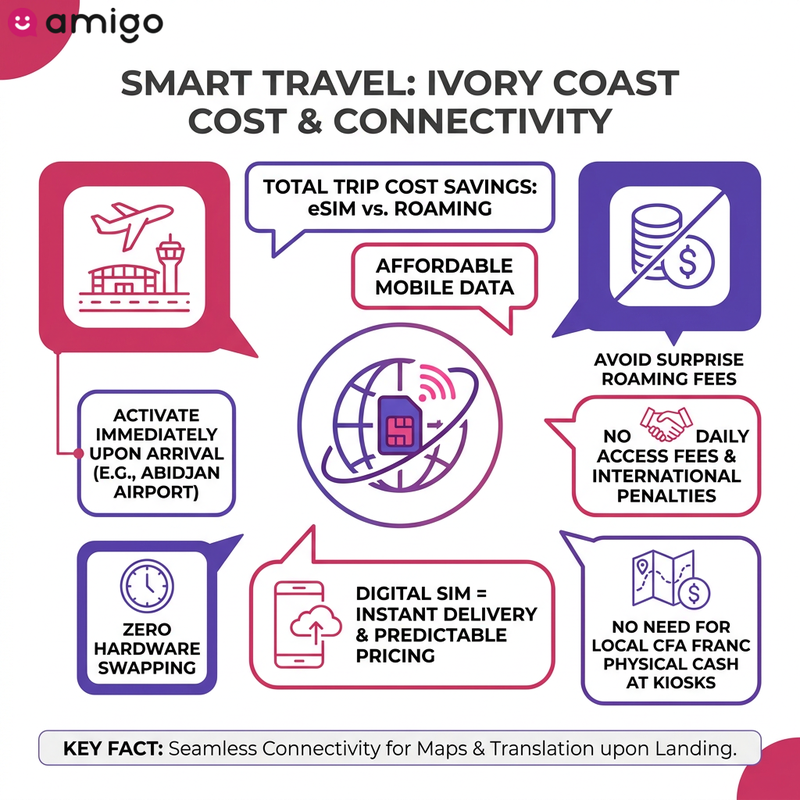
Using eSIM cards provides the best way to get affordable mobile data while visiting Ivory Coast. Digital SIMs are great because you get instant delivery, zero hardware swapping, and predictable pricing compared to traditional physical SIM cards. For seamless connectivity, purchasing a dedicated eSIM card for Ivory Coast provides instant internet access upon arrival. You can activate your plan immediately upon landing at Félix-Houphouët-Boigny International Airport in Abidjan. If you're anything like me, having your maps and translation apps working the second you step off the plane is an absolute lifesaver.
Avoiding roaming fees is an easy way to save money on your trip. Using an eSIM saves you from surprise roaming charges, such as daily access fees and international data penalties. Bypassing local telecom kiosks also eliminates the need to pay physical cash in the West African CFA Franc.